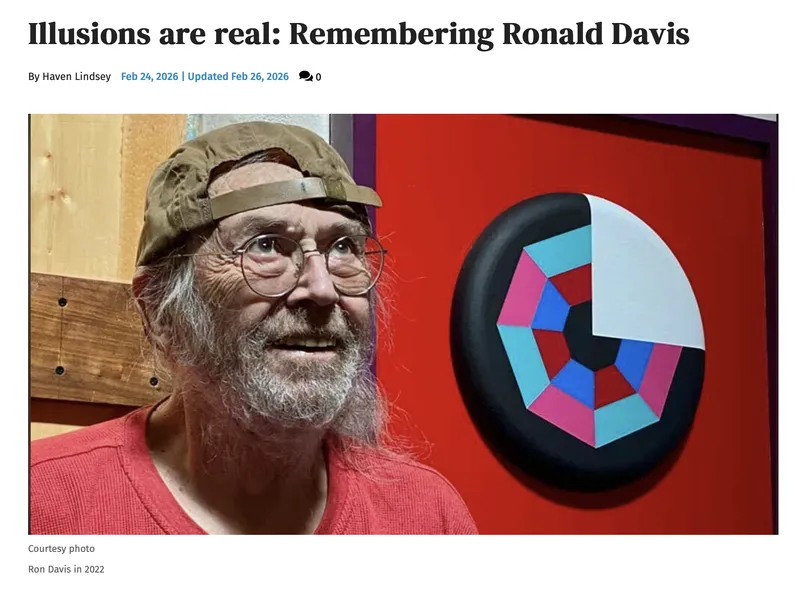
- By Haven Lindsey
On Sunday Feb. 15, 203 Fine Art and Gallery 215 hosted a memorial gathering for abstract illusionist painter Ronald Davis, whose passing on Nov. 19, 2025 marked the end of a singular and deeply influential artistic life. The walls of Gallery 215 were filled with Davis’ work, transforming the space into what felt like a spontaneous retrospective; a luminous reminder that, as he often said, “The paintings will take care of themselves.”
Davis, who died at age 88 at his home in Arroyo Hondo, leaves behind a legacy that stretches from the major museums of the world to the mesas of northern New Mexico. His work resides in the permanent collections of The National Gallery of Art, the Museum of Modern Art, the Tate Modern, LACMA, the Art Institute of Chicago and institutions across Europe and Australia. Yet on Sunday, the focus was not institutional acclaim but the living, breathing community that surrounded him. Artists, architects, curators, friends and family gathered beneath the geometry and gleam of his shaped canvases.
Born in Santa Monica in 1937 and raised in Cheyenne, Wyoming, Davis answered his calling in 1960, moving to San Francisco to study at the San Francisco Art Institute. From there, Los Angeles became both launchpad and proving ground. His early dealer, Nicholas Wilder, helped propel him into national prominence during the fertile art scene of the 1960s and ’70s. Davis moved confidently among figures such as Larry Bell, Judy Chicago, Walter Hopps, Ken Price and others shaping the course of postwar American art. His co-designed “tin house” studio-residence in Malibu in collaboration with with architect Frank Gehry, which embodied the same experimental spirit that defined his canvases.
Despite those defined canvases, Davis’ work defied confinement. Known for geometric abstraction and abstract illusionism, he worked with oil, acrylic, watercolor, printmaking, resin, fiberglass, computer-generated imagery and even electronic music composed on Buchla synthesizers. His later ‘Pixeldust’ renderings shimmered with digital precision, while his shaped canvases from the 1960s challenged the very boundaries of painting. His intensity was legendary. So was his humor.
In 1990, seeking respite from the pressures of Los Angeles, Davis relocated to the high desert of New Mexico. On the Arroyo Hondo mesa, in collaboration with architect Dennis Holloway and Diné anthropologist Charles Cambridge, he built a series of hogan-inspired dwellings and studios overlooking the Rio Grande Gorge. There, geometry met horizon line; illusion met sky.
The Feb. 15 memorial reflected Davis' expansive life. Among those present were artists Larry Bell and Paul Pascarella; Ron Cooper joined via Zoom from Oaxaca; architects Dennis Holloway and Charles Cambridge; and numerous friends from Davis’ San Francisco and Los Angeles years. Staff from the Harwood Museum of Art attended, along with Taos community members who had supported Davis’ decades in northern New Mexico.
Cambridge spoke movingly about Davis’ lifelong pursuit of spiritual balance and the challenge of reconciling ambition with serenity, and artistic rigor with inner harmony. That tension, visible in the taut precision of his paintings, defined much of his life’s work.
The gathering was infused with warmth and personality. Davis’ wife of 20 years, Barbara, described it as “a beautifully produced party” that became both mini-retrospective and family reunion. “So much love, so many hugs,” she reflected. In a fitting tribute to Davis’ sense of humor, the gallery team arranged for his favorite food, meatballs, to be served, which were indeed noteworthy.
“Ron had a great sense of humor, and he would have loved that touch,” Barbara added. “He could be a difficult character, but he always strived for authenticity, quality and beauty.” Quoting the Latin phrase, “Ars longa, vita brevis,” meaning art is long, life is short, Barbara captured the spirit of the sunny afternoon in one of Taos’ most unique gallery settings.
Maureen Sarro, executive director of 203 Fine Art, echoed Barbara’s sentiments. “Ronald Davis' impact on contemporary art is immeasurable. His pioneering approach to geometry, space and material challenged conventions and reshaped the language of contemporary abstraction. We are deeply grateful the community came together to share histories and joyful remembrances in honor of his remarkable life and enduring influence. The Ron-ism: ‘Illusions are real’ is one I will hold close.”
In 2021, Davis began a new series of more than 50 paintings. He completed his final work, titled ‘Timer,’ just four days before his death, effectively strong-arming age and pain to the very end. It was a characteristically defiant and poetic gesture.
With Gallery 215 filled with color and camaraderie, it was clear that the illusion Davis pursued was never about trickery. It was about perception: about seeing more deeply, more spiritually, more honestly and perhaps more feelingly. As Davis would likely have said, the paintings remain. The horizon remains. And for those gathered at Gallery 215, so did the sense that art, like illusion, is profoundly real.
